

Drive electronics are central to printhead performance. In practice, reliable jetting depends on maintaining precise control of signals, timing, waveform delivery and data handling across the system. GIS helps machine builders reduce that complexity and avoid the cost of solving known printhead control challenges through trial and error.
GIS drive electronics are configured around the printhead, the machine design and the production requirement. Depending on the printhead and system architecture, a configuration may use a direct connection to the printhead or an indirect architecture using a manager card and one or more printhead cards.
The right route depends on practical engineering factors: printhead type, number of heads, data requirements, cable lengths, available space, synchronisation needs and the wider machine design.
GIS works with OEMs and integrators to select the platform that gives the right balance of performance, scalability and integration simplicity.
Indirect Systems
Centralised control architecture
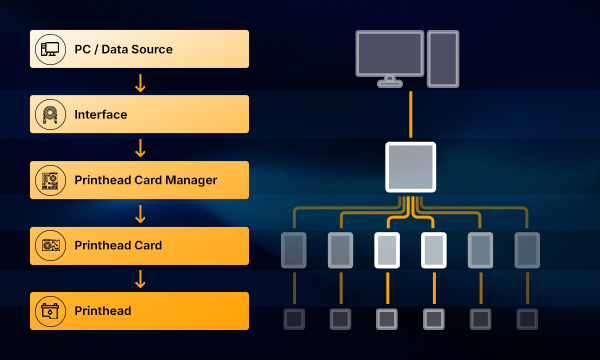
Indirect systems use a Printhead Card Manager to coordinate data distribution, waveform execution and power management, while individual printhead cards sit close to each printhead to maintain signal integrity.
Direct Systems
Distributed intelligent architecture
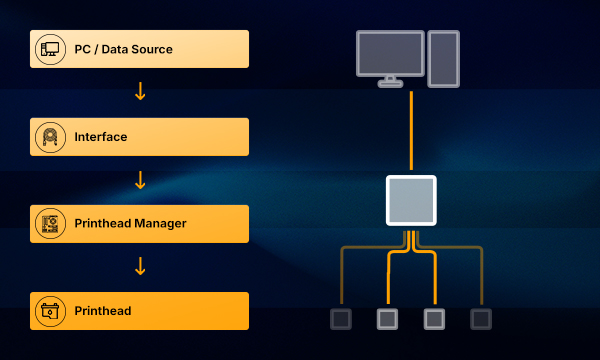
Direct systems place control at the printhead level, with each Printhead Manager independently handling data, waveform generation and power, enabling efficient scaling and high-throughput performance.
Click the links below for more information:
Indirect Architecture
In an indirect architecture, a manager card coordinates one or more printhead cards. The printhead cards provide the close-coupled interface to the printheads, while the manager card handles system-level functions such as data distribution, synchronisation, waveform execution and communication with the host system.
This can suit systems where the machine benefits from a distributed hardware layout, multiple printhead cards, or centralised coordination across the printhead drive electronics.
Direct Architecture
In a direct architecture, the printhead drive electronics connect to the printhead without a separate manager-card layer between the controller and the printhead interface.
This can suit systems where the electronic layout is compact, the printhead configuration is straightforward and the host system is positioned close to the printhead electronics. It can reduce the number of hardware layers in the system, depending on the printhead and configuration.
Key Benefits

High-fidelity waveform control enables precise droplet formation for improved print quality.

High data-rate capability supports demanding industrial applications with consistent throughput and synchronisation.

Optimised power management reduces overall energy consumption and removes the need for separate printhead power supplies.

Scalable architecture allows systems to grow from single-head setups to large industrial arrays.

Cost-efficient system design lowers total cost of ownership through reduced hardware complexity and faster development cycles.
Ethernet Systems
Industrial-grade scalable connectivity
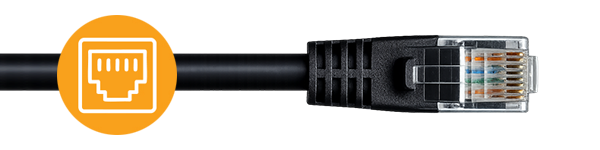
Ethernet systems support long cable runs and distributed configurations, making them ideal for production environments requiring robustness, scalability and integration into wider network infrastructure.
USB Systems
Compact and development-focused connectivity
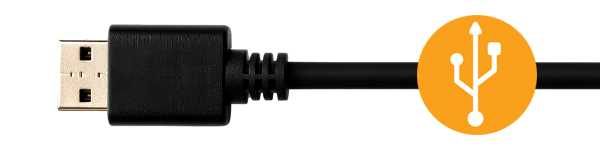
USB-based systems provide a simple, flexible platform for smaller or early-stage setups, offering straightforward integration and high printhead density within a compact footprint.
Ethernet vs USB
Ethernet platforms are suited to systems where communication between the host system and drive electronics may need to span longer distances or support distributed hardware. In the Samba Ethernet indirect example, the datasheet shows up to 100m from PC to Printhead Card Manager, with shorter connections from manager to card and card to printhead.
USB platforms support configurations where the host system and drive electronics are positioned close together. USB can provide a straightforward connection route for compact systems, development environments and machine layouts with shorter communication paths.
The suitability of Ethernet or USB depends on the printhead, data requirements, number of heads, cable lengths and the physical layout of the machine.
System building blocks
Choose USB or Ethernet platforms that scale from evaluation rigs to multi-head bars. Engineers gain precise control over waveforms and meniscus management, greyscale or multi-drop options where applicable, and real-time monitoring. Reference designs and proven components reduce integration risk and ease support.
GIS supports a wide range of printheads including Fujifilm Dimatix, Konica Minolta, Kyocera, Ricoh, Toshiba Tec, and Xaar. The capability to drive new printheads is being developed all the time, so if you do not find information the printhead you need, please contact us to discuss.
GIS Product Catalogue
Find your inkjet solution
Our PathFinder will guide you to the system you need.
Whether you’re an experienced developer or new to inkjet, our interactive tool guides you through key choices for your project and delivers tailored recommendations.
Inkjet Pathfinder
… or select a Printhead Manufacturer below
If you know the Printhead you will be using browse for the system solution below:


Next step…
Connect with us
We’d love to hear from you
If you are building a new machine or re-engineering a platform, talk to the GIS team. Want a more in-depth plan, or just a sanity check? Get in touch. We can set up a technical review through the form or take your call for a quick question.